
Macular degeneration is adiseasemainly affecting elderly subjects, leading to a progressive and irreversible loss of central vision. Agenetically transmissibledisease, it is responsible for a growing number of cases of low vision proportional to the increase in life expectancy.
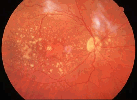
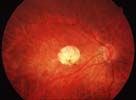
Affecting selectively the macular region, i.e., the area of the retina used to see objects fixed by the eye, this degeneration of retinal visual cells results in visual discomfort that is more or less noticeable at first. Gradually, the lesion increases in size, creating a blind spot (scotoma). Near vision (particularly reading) quickly becomes very difficult, even impossible. Examination of the fundus confirms the diagnosis.
Fluorescein angiographyof the fundus, an essential element to implement the treatment, allows the exact nature of the lesion in the affected eye to be specified and to search for precursor signs in the other eye. It may be a scarring form that progresses slowly. But sometimes it may be a neovascular form. In this case, angiography shows abnormal vessels rapidly developing under the retina. The fragility of these vessels leads to their rupture, responsible for hemorrhages with severe consequences. Photocoagulation of these new vessels by laser or their destruction by selective radiotherapy appear to be very promising therapies.